
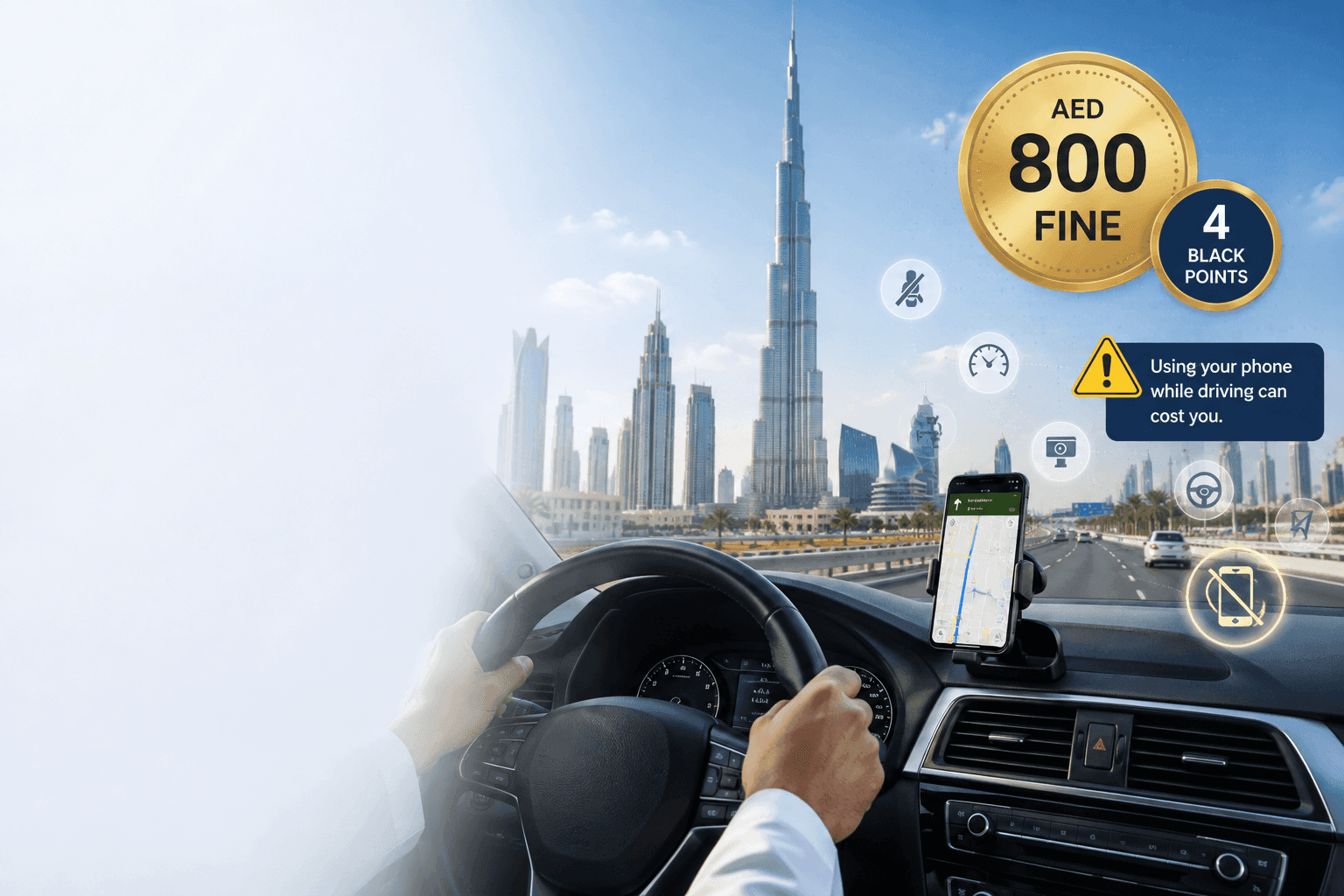
Phone Holder in Dubai Won’t Stop a Fine
A lot of drivers think that if it’s set on a dashboard or windshield holder, it’s safe to use on the road. This is a common misconception. A phone holder in Dubai and throughout the UAE doesn’t permit the use of your phone while driving. The authorities can fine you AED 800 and add 4 black points to your licence even if your cell phone is firmly attached to a mount. The legislation is targeting driver distraction and not the location of the phone.
Table of Contents
Is Using a Phone Holder Legal in Dubai?
Yes. Just a phone holder is okay. Install a phone holder in your vehicle to display navigation or have your device at an easy reach. But the owner does not waive the distracted driving laws. A violation occurs when the driver is operating the vehicle and is interacting with the phone. This includes any activity that distracts you from driving, including:
- Reading or sending messages
- Browsing social media
- Watching videos
- Holding the phone in your hand
- Scrolling through music playlists or other apps
The key issue is driver distraction, not the phone mount itself.
What Is the Penalty?
The UAE traffic rules prescribe the following fines to be imposed on the riders of electric bikes for using a handheld mobile phone while operating them:
- Fine: AED 800
- Black Points: 4
- Vehicle Impoundment: Generally none under the federal schedule for this offence.
The authorities also put in another category of “any other distractions” which carries the same punishment of AED 800 and 4 black marks. That entitles the enforcement authorities to consider that distractions outside of carrying a mobile phone can also lead to enforcement.
Why a Mounted Phone Can Still Result in a Fine
Many people think it is okay when using a mounted phone because both hands are on the wheel the majority of the time. That’s not the way the law is executed. When you’re distracted from traffic with your cell phone, you’re not paying attention to driving. Just a quick look can decrease reaction time.
These situations can still be a distracted driving violation:
- Responding to a WhatsApp message.
- Zooming in or out on Google Maps while driving.
- Adjusting navigation settings at a traffic signal.
- Looking to find a contact.
- Switching Playlists during a run.
A holder helps to keep the phone steady and prevents it from being a distraction, but it does not eliminate the distraction.
How Are Drivers Caught?
Dubai Police and other traffic authorities of the UAE utilize a mix of:
- Smart traffic cameras
- AI-assisted monitoring systems
- Roadside enforcement
- Traffic patrol officers
There are a number of risky activities that modern traffic monitoring systems can detect, such as mobile phone usage and other distractions. The authorities have admitted publicly to the use of AI-powered radar systems for the detection of different traffic offences.
As social media posts point out, cameras can monitor from all angles, but not all cameras are capable of detecting every type of infringement. There is no doubt that complicated monitoring technology and patrolling have been introduced to detect distracted driving.
Can You Use Google Maps?
Yes, but there are rules that are important. In Dubai, drivers often rely on navigation systems like Google Maps or Apple Maps to help them navigate and reach their destination.
To be on the safe side:
- Before you begin, type in your destination.
- Securely insert your phone into the phone holder.
- Follow voice directionals.
- Don’t touch the screen when driving.
If you must change your destination and/or your route, stop as safely as possible before making a phone call.
Are Hands-Free Calls Allowed?
Hands-free systems, Bluetooth, or built-in infotainment systems are typically safer than holding the phone. But drivers still have to pay close attention to the safety of the road. Even when conversing hands-free, there can be a distraction if it is not helpful to concentration. It is best to avoid making long telephone calls or to use them sparingly when driving especially under challenging conditions.
Does This Rule Apply at Red Lights?
A common misconception is that drivers can quickly check the odometer during traffic stops due to red lights and/or use their cell phones. This assumption is not to be taken for granted. You are still in traffic when your vehicle is temporarily stopped. Talking on a cell phone while waiting at a traffic signal can be considered distracted driving, depending on the situation and enforcement. Police continually warn drivers not to use cellphones during driving.
Safety Is the Main Reason
Distracted driving with a cell phone is still one of the top causes of collisions on the road around the world. Looking at a screen for only a few seconds can cause drivers to:
- Miss pedestrians.
- Not see unexpected stops.
- Maneuver to another track.
- Miss traffic signals.
- Respond inappropriately to emergencies.
These are risks that are being minimised by Dubai’s strict enforcement, which also seeks to make the roads safer for all.
Tips to Avoid an AED 800 Fine
Here are some simple tips to ensure UAE traffic compliance.
- Prior to travelling, set your GPS.
- Use voice-guided navigation.
- Use a secure stand for the phone.
- Do not hold a cell phone while driving.
- Please do not text, scroll or browse.
- Stop at a safe spot to use your device.
- Use Bluetooth or a hands-free phone if applicable.
- Drive without paying attention to the rear of the vehicle, particularly in the city.
Final Thoughts
While it is a handy accessory, a phone holder is NOT a legal defence against distracted driving in Dubai. The law does not prohibit mounting your phone. It, however, fines the use of or distraction from the device while driving. If you are found to have been distracted from the road by your phone, you could be fined AED 800 and receive four black points.
The only safe thing to do is keep it as simple as possible: make your navigation before you start driving, drive by voice and avoid using your phone until you’ve parked safely. This not only prevents the penalties from being charged, but it is also better for you, your passengers and all other road users.